
Which Business Is More Profitable In 2026?

Everyone wants to earn more money online – but with so many options out there, it is easy to get stuck asking the same question: which business is more profitable, and which one is actually worth your time?
The honest answer is that it depends on a few key things – your starting budget, how much time you can commit, and whether you want to trade hours for dollars or build something that scales. This article breaks down the most popular online business models, compares their real earning potential, and helps you figure out which one fits where you are right now in 2026.
Quick Answer: Ecommerce and dropshipping consistently rank among the most profitable online business models in 2026 – especially for beginners – because they offer low startup costs, scalable income, and no need to hold inventory. Freelancing and affiliate marketing are strong alternatives, but their earning ceilings depend heavily on your skills and audience size.
Before we get into the comparisons, it helps to understand what “profitable” actually means. A business with high revenue is not automatically the most profitable one. Profit is what is left after your costs – tools, ads, time, and overhead. With that framing in mind, let us look at what each model really delivers.

What does “most profitable online business” actually mean?
Profitability is a ratio, not just a revenue number. A freelancer billing $5,000 per month but spending 160 hours to get there is earning about $31 per hour before taxes. A dropshipping store generating $4,000 per month with 15 hours of weekly management is effectively earning far more per hour invested.
So when people ask which business is more profitable, the real question is: profitable relative to what – your time, your money, or your stress level?
In 2026, the most profitable online businesses share a few traits. They have low or no inventory risk. They can run without the owner being present every minute. They serve a global customer base. And they do not require years of audience-building before the first dollar arrives.
Ecommerce ticks all of those boxes, which is why it keeps appearing at or near the top of every honest profitability comparison.
That said, the “best” model is the one you will actually stick with long enough to see results. The fastest path to profit for a professional writer is not the same as the fastest path for someone starting completely from scratch. Keep that in mind as you read through the comparisons below.
How much can you realistically earn from an online business?
Let us be direct. Most online income figures you see in headlines are outliers, not averages. The person earning $50,000 per month from affiliate marketing has usually been building their platform for three to five years. The freelancer charging $200 per hour spent years getting to that rate. That does not mean those numbers are impossible – it just means they take time and consistency to reach.
Here is an honest breakdown of what each major model tends to deliver, especially in the first six to twelve months.
Dropshipping and ecommerce show the strongest combination of low startup cost, moderate effort, and scalable returns. Freelancing pays well but is capped by available hours, while affiliate marketing and content creation often take 12–18 months before meaningful income arrives.
One note on the ceiling figures: The top-end numbers above reflect consistent, full-time effort with smart product selection or skill positioning. Most part-time operators in months two to four earn in the lower half of each range. A realistic target for a beginner running a dropshipping store with 10–15 hours per week is $500–$1,500 per month by month three, scaling toward $3,000–$5,000 by month six with reinvestment.
It also helps to remember that these models are not mutually exclusive. Many successful online earners start with one model to build cash flow – often dropshipping or freelancing – and then layer in passive income streams like affiliate marketing or digital products over time. The question of which business is more profitable often becomes “which combination works best for my situation.”
The most profitable online business models compared
Below is a detailed breakdown of the six most popular models people use to earn money online in 2026. Each section covers how it works, its real profitability profile, and who it suits best.
Ecommerce and dropshipping
How dropshipping works
Dropshipping is a retail model where you sell products through your online store without holding any stock. When a customer places an order, it goes directly to your supplier, who ships the product straight to the buyer. You keep the margin between what the customer paid and what the supplier charges.
There is no warehouse, no upfront inventory purchase, and no fulfilment headache on your end.
In 2026, dropshipping remains one of the most accessible entry points into ecommerce because the barrier to starting is genuinely low. You do not need a large budget, a product idea, or a tech background. Platforms like AliDropship let beginners launch a fully functional store with products already loaded.
Earning potential: $500–$5,000+ per month by month three to six, scaling significantly with ad spend and product testing.
Profit margins in ecommerce
Typical dropshipping profit margins sit between 15% and 45% depending on the niche and supplier. Products in the home decor, pet accessories, and lifestyle categories often hit the higher end of that range. The key driver of profitability is product selection – finding items with strong demand and limited local availability gives you pricing power without aggressive ad spend eating into your margin.
Why this works in 2026: Global ecommerce is expected to surpass $6 trillion this year, and mobile shopping has made impulse buying faster and more frequent. Niche stores with targeted audiences consistently outperform general stores in both conversion rate and average order value.
Who it suits
Dropshipping is ideal for beginners with limited capital, people who want a scalable income stream without trading hours for dollars, and anyone who wants to build an asset they can eventually sell. It does require patience in the first 60–90 days while you test products and learn what converts, but the learning curve is gentler than most people expect.
Freelancing
How freelancing works
Freelancing means selling your skills directly to clients – writing, design, development, marketing, video editing, consulting, and dozens of other categories. Platforms like Upwork, Fiverr, and Toptal connect freelancers with businesses willing to pay for specific deliverables. The appeal is obvious: you can start earning quickly if you have a marketable skill.
Earning potential: $800–$4,000 per month for intermediate skill levels; $5,000–$15,000+ monthly for specialists or those with strong repeat client networks.
The limitation is equally obvious: freelancing is time-for-money. Every dollar you earn requires you to deliver work. There is no passive component unless you productize your service into a course, template, or agency model – which is a different business entirely. When comparing which business is more profitable over a five-year horizon, freelancing tends to plateau while ecommerce can compound.
Who it suits
Freelancing suits people who already have a defined skill and want income fast. It is not the most profitable long-term model, but it is one of the fastest to generate cash flow – often within the first two to four weeks. Many successful store owners actually start with freelancing to fund their ecommerce operations.
Affiliate marketing
How affiliate marketing works
Affiliate marketing involves promoting other companies’ products and earning a commission on each sale you drive. You build an audience – usually through a blog, YouTube channel, newsletter, or social media presence – and embed tracked links to the products you recommend. When someone buys through your link, you earn a percentage, typically between 3% and 50% depending on the program.
Earning potential: $100–$500 per month in the first year for most beginners; $2,000–$10,000+ per month for established content creators with significant organic traffic.
The time problem with affiliate marketing
Affiliate marketing is one of the most common answers to “which business is more profitable” in online discussions – but the timeline is frequently glossed over. Building the kind of audience that generates consistent affiliate income usually takes 12–24 months of consistent content creation. You are essentially building a media business first, with monetization as a secondary layer.
Important note: Affiliate income is entirely dependent on platforms and programs you do not control. Commission rates change, programs close, and algorithm shifts can wipe out organic traffic overnight. Diversifying beyond a single affiliate relationship is essential.
Who it suits
Affiliate marketing suits people who enjoy creating content, have an existing audience, or are willing to invest 12–18 months in building one. It is not the fastest path to profitability, but once an affiliate site achieves organic traction, it can generate income with minimal ongoing effort – making it a solid complement to an ecommerce store rather than a replacement.
Content creation and YouTube
How content creation works as a business
Content creators monetize their audience through ad revenue (YouTube Partner Program, blog display ads), sponsorships, merchandise, memberships, and affiliate deals. The top tier of creators earns millions per year. The median creator earns considerably less, and many earn nothing for the first 12–24 months.
Earning potential: $0–$500 per month in year one for most channels; $1,000–$10,000+ once a channel hits 50,000–100,000 engaged subscribers.
YouTube ad revenue alone pays approximately $2–$5 per 1,000 views (CPM varies wildly by niche and audience geography). A channel averaging 100,000 monthly views earns roughly $200–$500 from ads. Sponsorships and affiliate deals typically double or triple that figure – but only once you have a following worth sponsoring.
Who it suits
Content creation suits people who genuinely enjoy making videos, writing, or podcasting and are prepared to work without income for an extended period. It is one of the slowest paths to profitability when measured against the hours invested in year one. For comparison, a beginner dropshipping store typically reaches its first $1,000 month faster than a new YouTube channel reaches 1,000 subscribers.
Digital products
How selling digital products works
Digital products – ebooks, templates, courses, presets, software, and printables – are created once and sold repeatedly with no per-unit cost. This gives them theoretically unlimited profit margins once the creation cost is recovered. Platforms like Gumroad, Etsy (for digital downloads), and Teachable make distribution straightforward.
Earning potential: $200–$3,000 per month for sellers with an established niche and audience; top-tier course creators earn $10,000–$50,000+ monthly.
Who it suits
Digital products suit people with expertise in a high-demand area and an existing or buildable audience to sell to. The creation process can take weeks or months, and distribution without an audience is genuinely difficult. It is a highly profitable model at scale, but the upfront work requirement places it out of reach for complete beginners without a following.
Print on demand
How print on demand works
Print on demand (POD) lets you sell custom-designed products – t-shirts, mugs, phone cases, posters – without holding stock. A third-party fulfilment service prints and ships each item when an order comes in. Platforms like Printful and Printify integrate with Shopify, Etsy, and WooCommerce stores.
Earning potential: $100–$1,500 per month for active sellers; top POD stores on Etsy with strong design portfolios can exceed $5,000 per month.
Profit margins in POD are narrower than in standard dropshipping – typically 15–25% per product – because print-on-demand base costs are higher. The business model works best when combined with a strong niche identity and repeat buyer base rather than one-off generic designs.
When directly comparing which business is more profitable, POD generally underperforms standard dropshipping on margin, but it offers a creative outlet that appeals to design-oriented entrepreneurs.
Who it suits
Print on demand suits designers, artists, and creators who want to monetize their visual work without managing a traditional product business. It is a lower-ceiling model than broader ecommerce dropshipping, but a solid choice for someone with a defined aesthetic and an audience that already connects with their visual style.
Which business is more profitable: A side-by-side look at the real numbers
Let us be specific. Here is how the six models compare on the metrics that actually determine profitability – not just revenue, but margin, time-to-profit, and scalability.
Dropshipping stands out as the best balance of low startup cost, reasonable time-to-profit, and strong scalability. Freelancing gets to cash faster but does not scale without significant reinvention. Digital products have extraordinary margins but require either an existing audience or a lengthy content-building phase before sales become consistent.
Tips to maximize your online business profitability in 2026
Whichever model you choose, a few consistent principles separate people who see strong results from those who give up after two months of slow progress.
Pick a niche before you pick a product
The biggest mistake new ecommerce entrepreneurs make is choosing products randomly. The most profitable stores in 2026 are niche stores – built around a specific audience (pet owners, home gym enthusiasts, outdoor hikers) rather than a general “everything store” approach.
A niche audience is easier to target with ads, more likely to return for repeat purchases, and far more likely to share your store through word of mouth.
Treat your first 90 days as a testing phase
No business model becomes profitable immediately. The first 60–90 days in dropshipping are largely about testing – which products get clicks, which ads convert, which price points hold. Beginners who treat this phase as expensive failure often quit just before their data becomes valuable. Think of early ad spend as market research, not wasted money.
Reinvest early profits
The compounding effect of reinvesting your first $500–$1,000 in profit back into ads or product testing is what separates stores that plateau at $500 per month from those that hit $5,000 per month within a year. Resist the temptation to treat early earnings as salary. Treat them as fuel.
Focus on one traffic channel before diversifying
Facebook ads, Google Shopping, TikTok organic, Pinterest, and SEO are all legitimate traffic sources for ecommerce stores. The most common beginner mistake is trying all of them simultaneously and becoming mediocre at each. Master one channel first – ideally one that matches both your budget and your product type – and only expand once that channel is consistently profitable.
Understand your true costs before scaling
Scaling a business that is not yet truly profitable just creates bigger losses faster. Before increasing ad spend or expanding your product range, calculate your actual cost per acquisition (what you spend in ads to get one sale) versus your average order value and margin.
If your numbers are profitable at small scale, scaling becomes a straightforward multiplication exercise. If they are not, more budget will not fix a broken funnel.
Legal and ethical considerations for online businesses
Whichever online business model you choose, staying on the right side of the law is not just good ethics – it is essential for long-term profitability. Accounts that get banned, stores that face chargebacks, and affiliates who lose programm access all pay a steep price for short-term shortcuts.
What to avoid
Fake reviews are the most common grey-area practice in ecommerce, and they carry real risk. Platforms including Google, Trustpilot, and Amazon actively remove fake reviews and can delist stores that use them. Paying for reviews – even subtly structured incentive programms – violates most platform terms of service and can result in permanent account suspension.
Misleading income claims in affiliate marketing or content creation are another area to approach carefully. Regulatory bodies in the US (FTC), UK (ASA), and EU require disclosure of paid partnerships and prohibit unsubstantiated income claims. “I made $10,000 in my first month” without a disclaimer and context is both misleading and potentially illegal.
Important: Always disclose affiliate relationships clearly – a simple “this post contains affiliate links” near the top of your content is sufficient and required in most jurisdictions.
What to do instead
Build your store’s reputation through genuine product quality and customer service. Respond to negative reviews professionally rather than trying to bury them. Use real testimonials from actual customers, and offer a clear, fair returns policy.
These practices do not just keep you compliant – they build the kind of trust that drives repeat purchases and word-of-mouth growth, which are both free traffic and among the most profitable outcomes for any ecommerce store.
Key principle: A business built on transparency and real customer value is far more durable – and ultimately more profitable – than one built on inflated claims and gaming platforms.
Which business is more profitable for you – choosing by reader profile
There is no universal answer to which business is more profitable – only the right answer for your specific situation. Here is a breakdown by where you are starting from.
Complete beginner with limited budget
If you are starting with under $500, no existing audience, and no specialised skill you can immediately sell, dropshipping is your clearest path to profitability. A turnkey store gives you the fastest route from zero to operational, and the low inventory risk means your downside is capped.
Start with a niche that interests you, spend time learning one traffic source, and give yourself 60–90 days before drawing conclusions.
Intermediate – part-time income goal
If you already have some online experience and are targeting $1,000–$3,000 per month as a supplement to existing income, dropshipping or a hybrid of dropshipping plus affiliate content is a strong combination. Use your store to generate consistent revenue while building content that creates organic traffic over time. Within 6–12 months, the two channels start reinforcing each other.
Advanced – full-time income goal
If your target is replacing a full-time income – typically $3,000–$8,000 per month – you need a model that scales without proportional increases in your personal time. Dropshipping with automation, supplemented by digital products sold to your customer base, is one of the most profitable combinations available in 2026.
The ecommerce store generates consistent revenue; the digital products add high-margin upsells with no incremental fulfilment cost.
Career switcher or side hustler with an existing skill
If you have a professional skill – copywriting, design, video production, coding – consider freelancing for three to six months to build initial capital and cash flow, then funnel those earnings into a dropshipping store.
This is one of the fastest paths from zero to a diversified, profitable online income. You earn while you learn, and your freelance work often generates insights about market needs that directly inform your ecommerce niche selection.
AliDropship: Your complete all-in-one solution for starting dropshipping in 2026
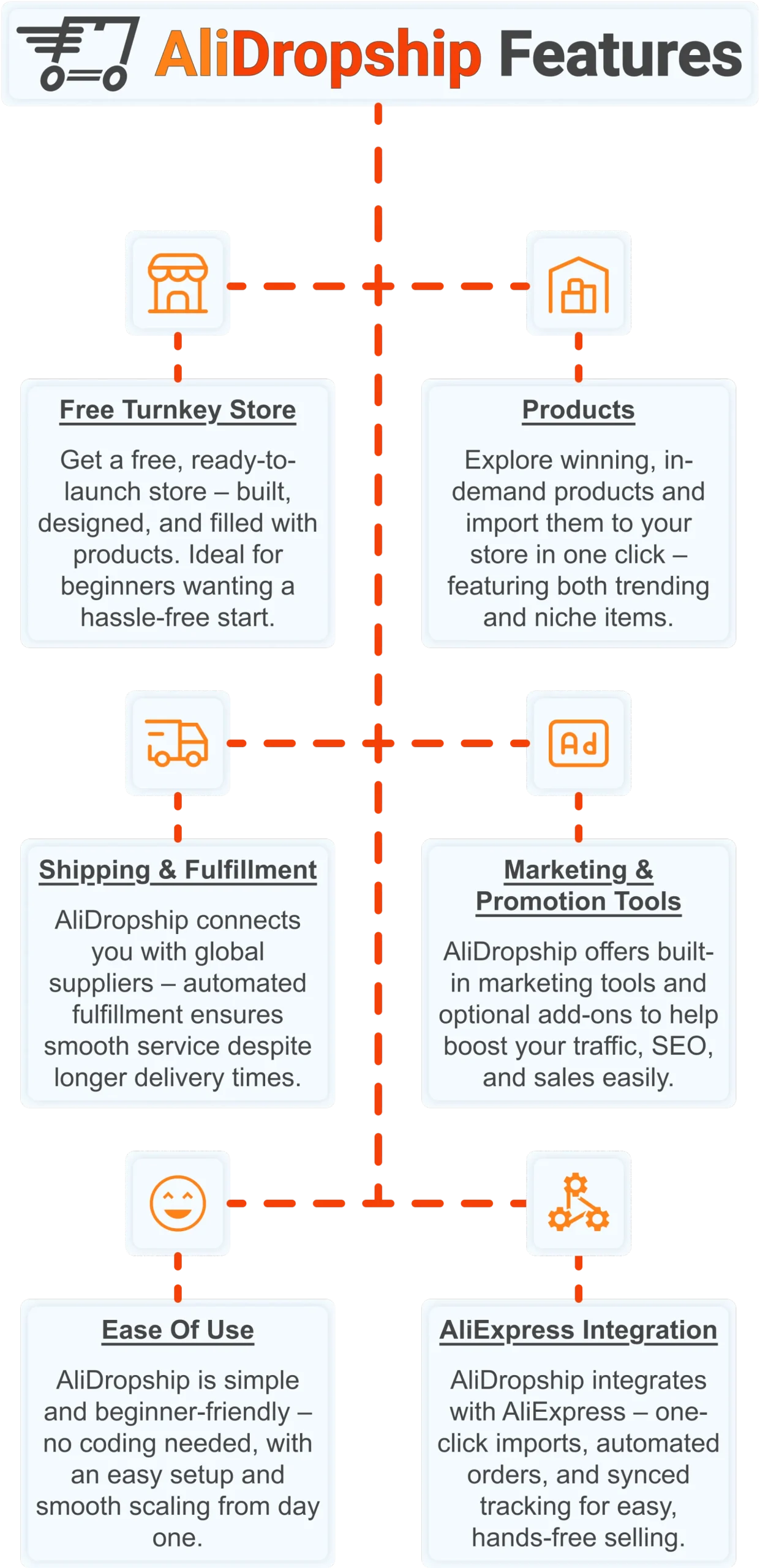
If you want the simplest possible way to start dropshipping – especially if you’re brand new – AliDropship remains one of the most beginner-friendly tools available in 2026. It brings together store creation, product imports, automation, and marketing into a single streamlined system designed to help you launch quickly and grow confidently.
Free turnkey store 🛍️
Get a free turnkey store – built, designed, and filled with products. Ideal for beginners wanting a hassle-free start, the store comes fully optimized to attract customers right away, saving you time on setup. Plus, it includes professional design elements to give your business a polished, trustworthy look from day one. This ready-made foundation makes it easy to move seamlessly into product selection.
Products 📦
Once your store is set up, you can explore winning, in-demand products and import them in one click – featuring both trending and niche items. This wide selection lets you cater to diverse customer interests and test what works best. Regular updates ensure you always have fresh products, keeping your store competitive and relevant. With great products in place, smooth shipping becomes the next essential step.
Shipping & fulfillment 🚚
AliDropship connects you with global suppliers, and automated fulfillment ensures seamless order processing despite international delivery times. Customers receive real-time tracking updates, which builds confidence and trust in your store. Once shipping is handled reliably, you can focus on promoting your store and attracting traffic.
Marketing & promotion tools 📣
To maximize sales, AliDropship offers built-in marketing tools and optional add-ons that help boost traffic, SEO, and conversions. From email campaigns and discounts to social media integration, these tools empower you to reach and retain customers without needing prior marketing experience. With promotion strategies in place, managing your business becomes simpler and more efficient.
Ease of use 👌
AliDropship is beginner-friendly – no coding needed, with an intuitive dashboard that guides you through every step. Easy setup and smooth scaling let you expand your store without stress. As your business grows, adding new features, products, and marketing campaigns remains hassle-free, giving you more time to focus on sales.
AliExpress integration 🛒
Finally, AliDropship integrates seamlessly with AliExpress, enabling one-click imports, automated orders, and synced tracking. Your inventory stays up-to-date with the latest products and prices, while automated order processing frees you from manual tasks. Combined with the turnkey setup, reliable shipping, and built-in marketing tools, this integration ensures your dropshipping business is fully equipped for growth and success.
Of all the models covered in this article, dropshipping with AliDropship is consistently the most profitable starting point for beginners who want scalable income without large upfront costs. Get your free turnkey store today and start building a business that earns.
Which business is more profitable: dropshipping or freelancing?
What is the most profitable online business for beginners in 2026?
Dropshipping is widely regarded as the most accessible and profitable starting point for online beginners in 2026. It does not require a pre-existing skill, audience, or large budget. Platforms like AliDropship provide a turnkey store with products already loaded, which removes much of the setup barrier. Most beginner dropshipping stores reach their first 500 to 1,500 dollars per month within two to four months of consistent effort. Affiliate marketing and digital products are also profitable but typically require 12 to 18 months before generating meaningful income.
How long does it take for a dropshipping store to become profitable?
Most beginner dropshipping stores begin to see consistent sales within the first 30 to 60 days, with profitability – meaning revenue exceeding all costs including ads – typically arriving between months two and four. Full-time income levels of 3,000 to 5,000 dollars per month are realistic within six to nine months for stores that reinvest early profits into product testing and ad optimization. The timeline varies based on niche selection, ad budget, and how quickly the store owner learns from early data. Treating the first 90 days as a testing and learning phase rather than expecting immediate profit is the mindset that leads to long-term success.
What is a realistic ecommerce profit margin for a new store?
New dropshipping stores typically achieve profit margins between 15 and 35 percent of revenue after all costs – including product cost, shipping, advertising, and platform fees. Some niches, particularly home decor, pet accessories, and lifestyle products, can reach 40 to 45 percent margins with strong supplier relationships and effective niche targeting. Margins tend to improve over time as store owners negotiate better supplier rates and their ad targeting becomes more efficient. It is important to factor in advertising spend when calculating real profitability – a store with a 40 percent gross margin but a high cost per acquisition can still be unprofitable at small scale.
Can you run a profitable online business with no experience?
Yes, running a profitable online business with no prior experience is genuinely achievable in 2026, particularly with models like dropshipping that are designed for beginners. Turnkey store solutions remove the technical barrier entirely, and free resources including YouTube tutorials, community forums, and platform documentation provide a solid foundation. Most successful beginner store owners spend their first month learning the basics of ad targeting and product research before launching their first campaign. Starting with a defined niche, a modest ad budget of 200 to 300 dollars, and a willingness to test and adjust is a realistic blueprint for a profitable first year.


