
Customer Acquisition Cost (CAC)
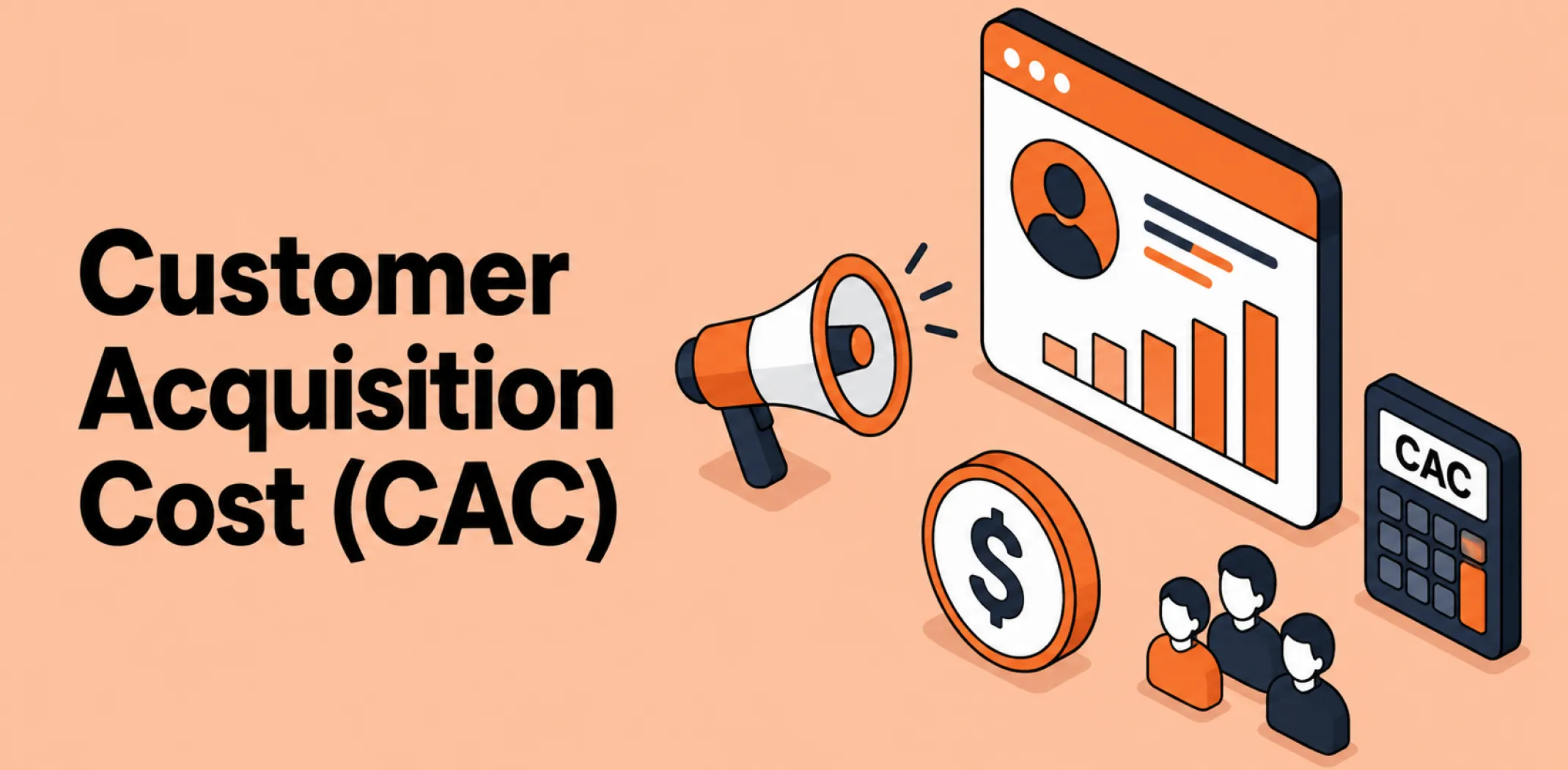
Customer acquisition cost (CAC) is the total amount a business spends, on average, to acquire a single new paying customer, calculated by dividing total sales and marketing expenditure over a given period by the number of new customers gained in that same period.
CAC aggregates all costs directly tied to winning new customers: paid advertising, content production, influencer fees, platform fees, sales tools, and any staff time allocated to product advertising or outreach campaigns. The figure is expressed as a monetary value per customer and is used to determine whether a store’s growth is financially sustainable.
In dropshipping and broader ecommerce, CAC is most meaningful when compared against customer lifetime value (CLV or LTV). A store where CAC consistently exceeds or approaches CLV is acquiring customers at a loss, regardless of revenue volume.
The relationship between these two figures is a primary indicator of long-term business viability. Understanding CAC also informs decisions about ecommerce marketing strategies and budget allocation across channels.
Example
A dropshipping store selling home organisation products spends $1,200 in a month on Facebook ads, $300 on product photography for ad creatives, and $150 on an email marketing platform – a total of $1,650. During that month, the store acquires 55 new customers. Dividing $1,650 by 55 gives a CAC of $30. If the store’s average order value is $45 and customers typically purchase only once, the margin available after supplier cost and CAC is narrow. The store owner may then evaluate whether improving the conversion funnel or increasing average order value could make the acquisition cost sustainable.
Key characteristics
- Formula: CAC = total sales and marketing spend ÷ number of new customers acquired, measured over a consistent time period.
- Scope of costs included: All expenditure required to attract and convert a new customer counts – paid ads, creative production, platform fees, and applicable staff costs.
- Channel-level calculation: CAC can be calculated per marketing channel (e.g., paid search, social media, email) to identify which channels acquire customers most efficiently.
- Relationship to CLV: A healthy business typically targets a CLV-to-CAC ratio of 3:1 or higher, meaning a customer generates at least three times what it cost to acquire them.
- Time sensitivity: CAC changes as ad costs, competition, and conversion rates shift, so it requires regular recalculation rather than a single baseline measurement.
Related terms
- Customer lifetime value – the total revenue a business can expect from a single customer across all their purchases, used alongside CAC to assess acquisition efficiency.
- Return on investment – a broader profitability metric that measures the gain or loss from an investment relative to its cost, often used to evaluate marketing campaigns in aggregate.
- Conversion funnel – the staged path a visitor travels from first contact to purchase; optimising the funnel directly reduces CAC by converting more visitors with the same ad spend.
- Product advertising – the paid and organic promotion of specific products, representing one of the primary cost inputs in a CAC calculation.
- Average order value – the mean revenue per transaction; increasing it improves the margin available to absorb acquisition costs without reducing profitability.
Frequently asked questions
What is a good customer acquisition cost for a dropshipping store?
There is no universal benchmark because an acceptable CAC depends on the product’s price point, profit margin, and how often customers are likely to repurchase. As a general guide, CAC should remain well below the gross profit generated by a single order – and ideally below one-third of the customer’s projected lifetime value.
What costs should be included in a CAC calculation?
CAC should include all expenses directly linked to acquiring new customers: paid advertising spend, creative and content production costs, influencer or affiliate fees, marketing platform subscriptions, and any staff time dedicated to customer acquisition activities. Costs associated with serving or retaining existing customers are excluded.
How can a dropshipping store lower its CAC?
CAC can be reduced by improving conversion rates on existing traffic, refining audience targeting to reduce wasted ad spend, testing lower-cost channels such as organic content or email, and using upselling and cross-selling to increase revenue per acquired customer rather than spending more to acquire new ones.
Is CAC the same as cost per click (CPC)?
No. Cost per click measures what an advertiser pays each time a user clicks an ad, while CAC measures the total spend required to convert a prospect into a paying customer. CPC is one input that can affect CAC, but CAC accounts for the full acquisition cost including clicks that do not result in a purchase.
AliDropship: An all-in-one platform for starting dropshipping in 2026
AliDropship is a dropshipping platform that covers store creation, product imports, order automation, and marketing within a single system. It is designed for users with no prior ecommerce experience, though it also supports scaling for more established stores.
🛍️ Free turnkey store
New users receive a free pre-built store – set up, designed, and stocked with products. The store includes a ready-to-use product catalogue and a standard storefront design. It also comes with hosting, a domain, SSL, and payment systems already set up and included.
📦 Products
The platform provides access to a product catalogue covering both trending and niche items, with one-click import to your store. The catalogue is updated regularly to reflect current market availability. Products can be browsed, filtered, and added without leaving the platform.
🚚 Shipping & fulfillment
AliDropship provides access to a vast catalogue of products from global suppliers and handles order fulfillment automatically once a purchase is made. Customers receive tracking information directly, and orders are processed without manual intervention from the store owner.
📣 Marketing & promotion tools
The platform includes built-in marketing tools covering email campaigns, discount management, SEO settings, and social media integration. These are available within the dashboard and do not require third-party subscriptions for basic use.
👌 Ease of use
AliDropship requires no coding knowledge. The dashboard contains all the necessary tools for managing your store, products, and orders in one place. Additional features and products can be added as the store grows without rebuilding the existing setup.
Are you ready to become an owner
of a profitable online business?
Free Dropshipping Guide