
Hybrid Dropshipping
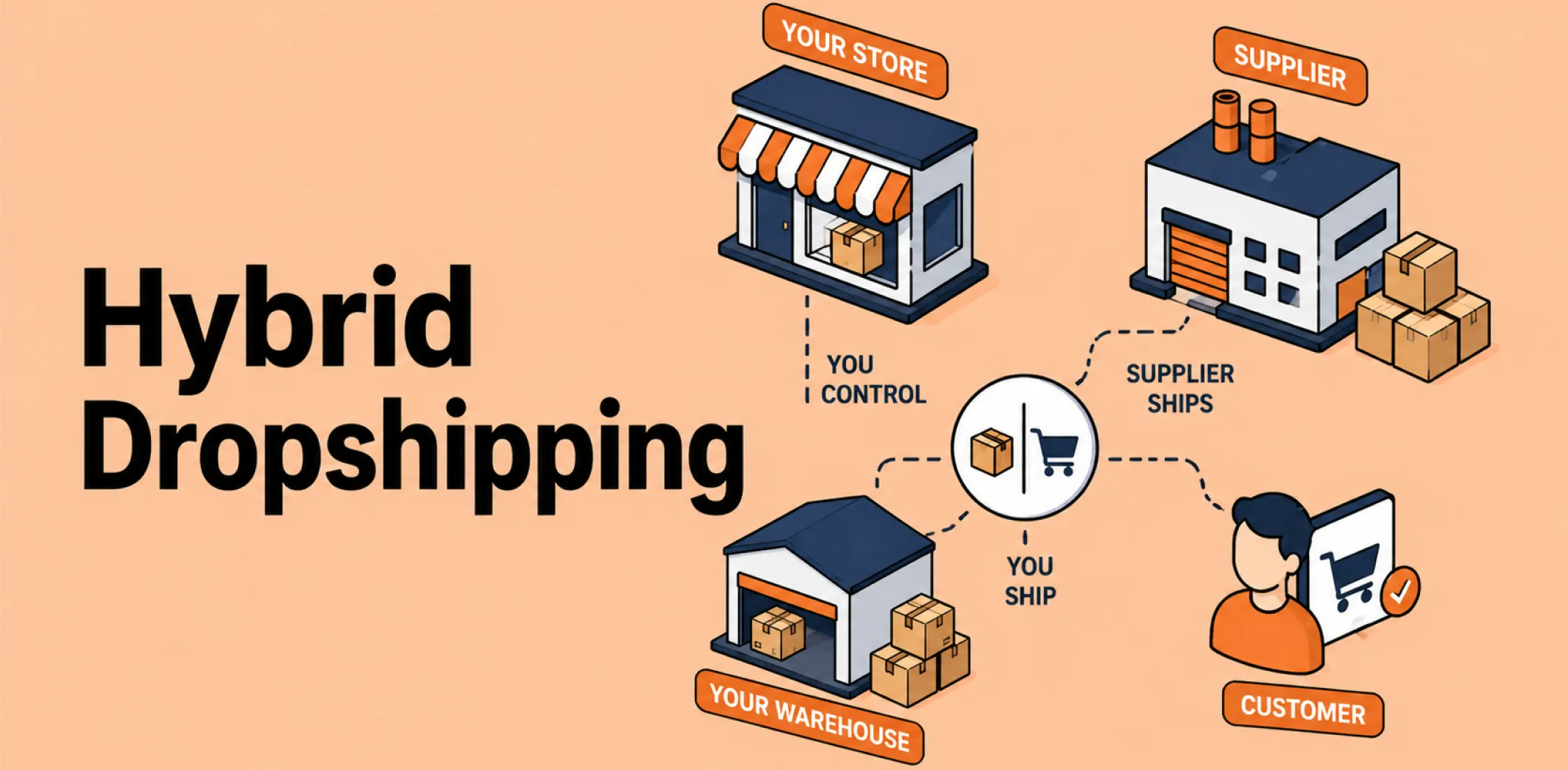
Hybrid dropshipping is a fulfillment strategy that combines traditional inventory-holding with supplier-managed dropshipping within a single ecommerce operation, allowing a store to apply the most appropriate model to each product or order based on demand patterns, margin targets, and operational constraints.
In a pure dropshipping model, the retailer holds no inventory and forwards every order to a supplier. In pure wholesale, the retailer purchases and stores all stock before any sale. Hybrid dropshipping sits between these extremes.
The store owner identifies which products justify the capital investment of bulk purchasing — typically best-sellers with predictable demand — and purchases those for in-house warehousing. For slower-moving items, seasonal products, or untested niches, the same store forwards customer orders directly to dropshipping suppliers.
This model evolved as successful dropshipping stores accumulated sales data and working capital. It solves the core limitation of pure dropshipping — thin per-unit margins — without requiring the store to hold inventory for every product. Hybrid operations typically achieve higher overall profitability than either pure model alone while maintaining the flexibility to test new products without inventory risk.
How hybrid dropshipping works
- The store owner analyzes historical sales data to identify products with consistent monthly volume, low return rates, and stable supplier pricing — these become “inventory candidates.”
- For each candidate product, the owner purchases a bulk quantity from the supplier at wholesale rates and stores the inventory in a local warehouse or fulfillment center.
- For slow-moving, new, or seasonal products, the store continues using standard dropshipping: the supplier ships directly to customers with no inventory held by the store.
- When a customer orders an in-stock product, the store ships from its own inventory — typically using faster shipping methods and custom blind dropshipping packaging with the store’s branding.
- When that same product goes out of stock or exceeds forecasted demand, the store can temporarily fall back to supplier-managed dropshipping as a backup fulfillment method, preventing stockout-related lost sales.
Example
A home goods store sells 15 different kitchen gadgets. Their top three products — a garlic press, a citrus juicer, and a herb chopper — generate 70% of monthly revenue. The store buys 300 units of each top seller at wholesale ($4 per unit) and stores them in a spare room, paying $0.50 per unit for custom-branded boxes. When a customer orders the garlic press, the store ships it same-day for $3.50 via local courier. For the remaining 12 low-volume products, the store uses standard dropshipping: a supplier in China ships directly to customers in 10-14 days. The hybrid approach gives the store $9 profit on the garlic press (versus $5 if dropshipped), while maintaining zero inventory risk on slower products.
Key characteristics
- Dual fulfillment infrastructure: The store maintains relationships with both wholesale suppliers (for bulk inventory) and dropshipping suppliers (for direct fulfillment), often using different suppliers for different tiers of products.
- Demand-driven inventory allocation: Products move between fulfillment models over time — a high-performing dropshipped product may transition to wholesale inventory, while a slow-moving stocked product may revert to dropshipping to clear existing bulk stock without repurchasing.
- Fallback fulfillment capability: Even for products held in inventory, the store retains the ability to route individual orders back to the dropshipping supplier if in-house stock is temporarily exhausted, eliminating stockout exposure.
- Margin optimization lifecycle: The store captures wholesale margins on high-volume products while using dropshipping margins for testing and tail products, resulting in blended margins that typically exceed pure dropshipping by 10-20 percentage points.
Related terms
- Dropshipping — the baseline fulfillment model in which the retailer holds no inventory and suppliers ship directly to customers.
- Wholesale vs dropshipping — the comparative framework that hybrid models bridge by combining elements of both approaches.
- Warehousing — the physical storage component that hybrid operations add for their highest-volume products.
- Average order value — a key metric that hybrid fulfillment can improve because in-house inventory enables faster shipping and custom packaging, encouraging larger purchases.
- Order fulfillment — the broader process of receiving, processing, and shipping orders, executed through two different channels in a hybrid model.
Frequently asked questions
Is hybrid dropshipping more profitable than regular dropshipping?
Yes, for established stores with sufficient sales volume to identify best-selling products. Hybrid models typically increase gross margins by 10-20 percentage points on the products moved to in-house inventory. However, hybrid dropshipping requires working capital for inventory purchases and introduces stock management complexity that pure dropshipping avoids entirely.
When should a dropshipping store switch to a hybrid model?
The transition typically makes sense when three conditions are met: the store has consistent monthly revenue above $10,000, at least three products each generate 50+ sales per month, and the store has accumulated enough cash reserves to purchase 60-90 days of inventory for those top products without depleting operating capital.
Do customers notice the difference between hybrid fulfillment methods?
Customers receive different shipping experiences depending on which fulfillment method applies to their order. In-house inventory typically ships faster (2-5 days) and arrives in branded packaging, while dropshipped items may take 10-14 days in unbranded packaging.
Savvy customers may notice the inconsistency. Successful hybrid operators maintain consistent presentation by using blind dropshipping packaging for both channels and setting realistic delivery expectations upfront for all products.
Can you run hybrid dropshipping from a single platform?
Yes, most ecommerce platforms including AliDropship, Shopify, and WooCommerce support hybrid fulfillment through inventory management features. The store configures some products with local stock tracking and others as “dropship-only.” Order routing logic directs in-stock items to the store’s own fulfillment workflow and forwards dropshipped items to supplier APIs or manual order submission.
AliDropship: An all-in-one platform for starting dropshipping in 2026
AliDropship is a dropshipping platform that covers store creation, product imports, order automation, and marketing within a single system. It is designed for users with no prior ecommerce experience, though it also supports scaling for more established stores.
🛍️ Free turnkey store
New users receive a free pre-built store – set up, designed, and stocked with products. The store includes a ready-to-use product catalogue and a standard storefront design. It also comes with hosting, a domain, SSL, and payment systems already set up and included.
📦 Products
The platform provides access to a product catalogue covering both trending and niche items, with one-click import to your store. The catalogue is updated regularly to reflect current market availability. Products can be browsed, filtered, and added without leaving the platform.
🚚 Shipping & fulfillment
AliDropship provides access to a vast catalogue of products from global suppliers and handles order fulfillment automatically once a purchase is made. Customers receive tracking information directly, and orders are processed without manual intervention from the store owner.
📣 Marketing & promotion tools
The platform includes built-in marketing tools covering email campaigns, discount management, SEO settings, and social media integration. These are available within the dashboard and do not require third-party subscriptions for basic use.
👌 Ease of use
AliDropship requires no coding knowledge. The dashboard contains all the necessary tools for managing your store, products, and orders in one place. Additional features and products can be added as the store grows without rebuilding the existing setup.
Are you ready to become an owner
of a profitable online business?
Free Dropshipping Guide