
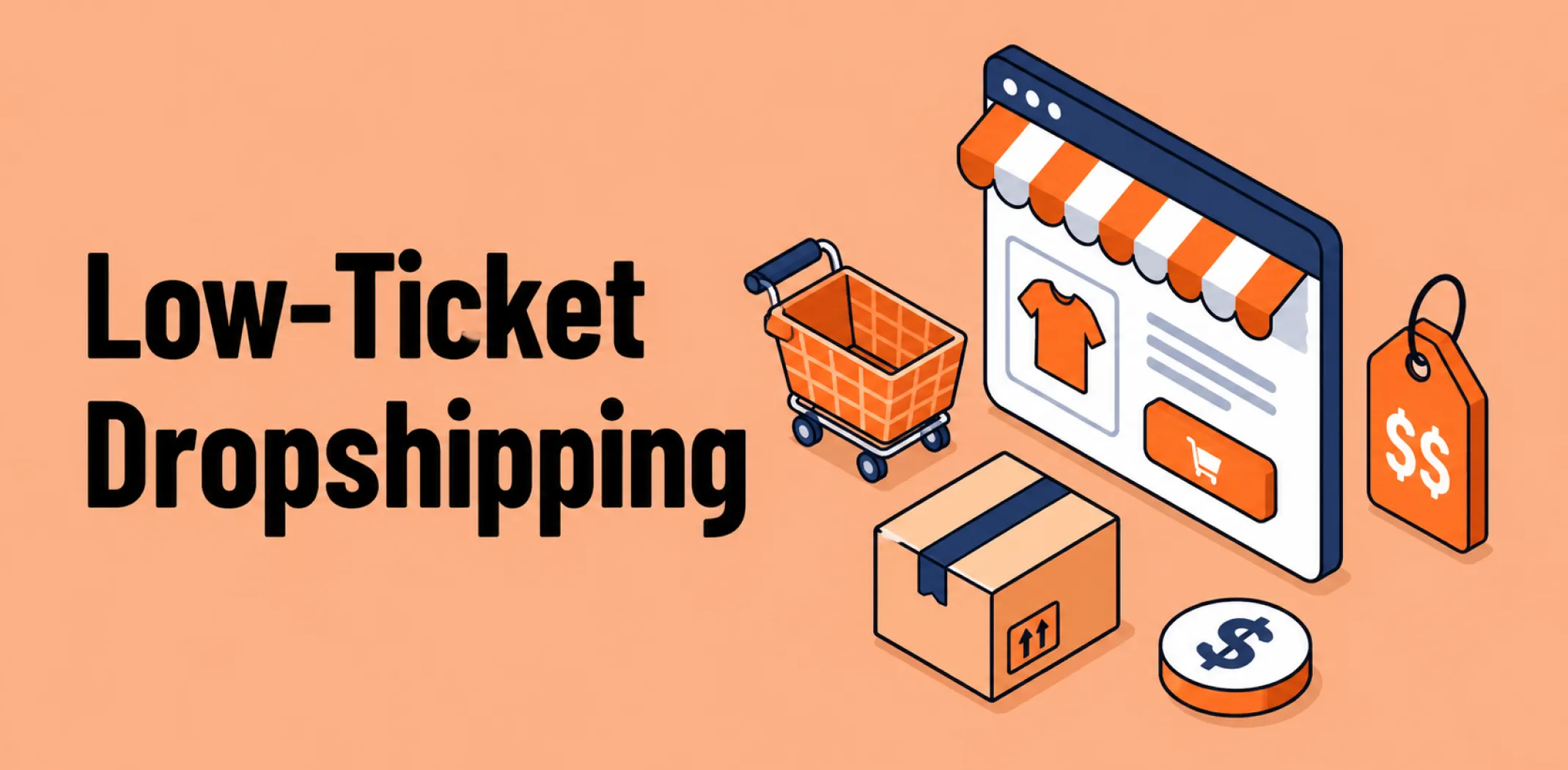
Low-Ticket Dropshipping
Low-ticket dropshipping is a retail fulfillment model in which a seller offers low-priced products – typically under $50 – without holding inventory, forwarding each customer order to a third-party supplier who ships the item directly to the buyer.
Within the broader dropship landscape, low-ticket refers specifically to the price tier of the products sold, as distinct from mid-ticket or high-ticket dropshipping, which involve products priced in the hundreds or thousands of dollars. Low-ticket items – phone accessories, kitchen gadgets, pet supplies, and similar everyday goods – generate purchases with minimal buyer deliberation, which means higher conversion rates but also thinner per-order margins.
Because acquisition costs and return rates follow different patterns at lower price points, low-ticket operations rely on order volume rather than per-unit profit to achieve revenue targets. Platforms such as AliExpress are frequently used as sourcing channels for low-ticket products due to the depth of available inventory in everyday consumer categories.
How low-ticket dropshipping works
- The store owner selects low-priced products from a supplier catalogue – commonly items retailing between $5 and $50 – and lists them in an online store at a marked-up price.
- A customer visits the store, adds a product to their cart, and completes the purchase at the retail price set by the store owner.
- The store owner receives the payment, then places an order with the supplier at the lower wholesale cost, providing the customer’s shipping address.
- The supplier packages and ships the item directly to the end customer, typically under the store owner’s branding if blind dropshipping is arranged.
- The store owner retains the difference between the retail price and the supplier cost as gross profit, from which advertising and platform fees are deducted.
- Because margins per order are narrow, the store owner scales through traffic volume – running paid social campaigns or optimising for organic discovery – to generate sufficient order counts for profitability.
Example
A store owner builds a general store focused on home organisation products, listing a wall-mounted cable tidy at $18.99 – sourced from a seller on AliExpress at $4.20. When a customer places an order, the store owner forwards the details to the supplier, who ships the item directly. After the $4.20 supplier cost and roughly $7 in advertising spend, the store owner clears around $7.79 per order – a margin that becomes meaningful only at volume. To reach $1,000 in net monthly profit at that per-order return, the store requires approximately 129 completed orders, making consistent ad performance and a high-converting landing page central to the operation.
Key characteristics
- Low price point: Products are typically priced under $50, positioning them as impulse or low-deliberation purchases for the average consumer.
- Volume dependency: Profitability depends on processing a high number of orders per period, since the gross margin on any individual sale is modest.
- High conversion potential: Inexpensive products face less purchase resistance, which generally produces higher add-to-cart and checkout completion rates compared with high-ticket items.
- Advertising sensitivity: Because per-order profit margins are narrow, customer acquisition costs must be tightly managed – a small rise in cost-per-click can eliminate margin entirely.
- Supplier breadth: The low-ticket price range maps closely to the inventory depth available on large wholesale marketplaces, giving store owners a wide pool of products to test.
Related terms
- Dropship – the fulfillment model underpinning low-ticket dropshipping, in which a supplier ships orders directly to the end customer on the seller’s behalf.
- Niche market – a defined consumer segment that low-ticket store owners often target to reduce competition and improve ad relevance.
- Average order value – a key metric in low-ticket operations, frequently increased through bundling or cross-sell offers to offset thin per-unit margins.
- Conversion funnel – the sequence of steps a visitor moves through before completing a purchase, which is critical to optimise when operating on low per-order margins.
- Order fulfillment – the process by which the supplier receives, packages, and dispatches an order to the customer after the store owner forwards the purchase details.
- Upselling – a technique commonly used in low-ticket stores to raise the effective revenue per transaction beyond the base product price.
Frequently asked questions
What price range counts as low-ticket in dropshipping?
Low-ticket products are generally those retailing below $50, though the boundary is not formally defined and some practitioners place the threshold as low as $30. The defining characteristic is that the purchase is made with minimal deliberation – the customer does not need to research extensively or seek approval before buying.
Is low-ticket dropshipping still profitable?
Low-ticket dropshipping remains viable, but profitability depends on maintaining a favourable ratio between customer acquisition cost and gross margin per order. As advertising costs on major platforms have risen, store owners increasingly rely on strategies such as organic traffic, email retention, and upsells to sustain margins. For a broader analysis, see is dropshipping still profitable.
How does low-ticket dropshipping differ from high-ticket dropshipping?
High-ticket dropshipping involves products priced in the hundreds or thousands of dollars – items such as furniture, fitness equipment, or specialist tools – where a single sale generates significant margin but requires more customer trust and longer decision cycles. Low-ticket dropshipping trades higher per-order profit for lower purchase friction and faster inventory turnover, requiring volume to achieve equivalent revenue.
What are common product categories in low-ticket dropshipping?
Frequently sold low-ticket categories include phone accessories, kitchen gadgets, beauty tools, pet accessories, home organisation products, and novelty items. These categories share high consumer familiarity, broad demographic appeal, and availability through large wholesale suppliers.
What is AliDropship?
AliDropship is a user-friendly platform that provides you with turnkey ecommerce solutions, making dropshipping smooth and hassle-free – from sourcing products to fulfilling orders. It takes care of technical stuff and fulfillment, so you can focus on sales, marketing, and growing your business without stress. ✨
Why choose AliDropship as your dropshipping partner?
AliDropship is packed with features designed to make your dropshipping journey easier and more efficient. Here’s what makes it stand out:
⚙️ Powerful automation
Automate essential tasks like product importing, order processing, and inventory tracking. Save time and focus on scaling your business without getting stuck in manual work.
🛍️ High-profit “winning” product database
The ecosystem provides access to a curated database of thousands of products that have been manually vetted for high profit potential and shipping reliability. You aren’t just guessing what might sell; you are leveraging data-backed insights from stores already succeeding in the ecosystem.
🔄 Seamless AliExpress integration
Effortlessly connect with AliExpress suppliers and access a huge variety of high-quality products. Real-time updates ensure accurate pricing, stock levels, and product details – eliminating the need for manual inventory management.
🎨 Turnkey solutions
The platform offers turnkey solutions for your business: pre-built store, pre-selected products catalogue, tried and tested marketing campaigns, whatever you might need for your business setting up and growth.
🤝 Comprehensive support
Whether you’re just starting with dropshipping or already an experienced seller, AliDropship offers tutorials, guides, and a dedicated support team to help you every step of the way.
🎯 Free trial
AliDropship provides you with access to its ecosystem for free, giving you a turnkey dropshipping store ready to sell from day 1. Your store is already pre-built and comes entirely for free even after the trial ends (hosting, domain, and SSL included if you subscribe after the trial).
🌎 Global reach
Sell to customers worldwide with support for multiple languages and currencies. Expanding into international markets has never been easier.
📢 Built-in marketing tools
Increase your store’s visibility with SEO optimization, email integration, and social media tools designed to drive traffic and boost sales.
📚 Community & educational resources
Join a thriving community and access valuable resources like blogs, forums, and webinars to stay ahead with trending products and smart marketing strategies.
AliDropship makes launching and managing your dropshipping business simple with powerful automation, customization, and marketing tools. Whether you’re selling locally or globally, this platform gives you the flexibility and reliability to grow your online store. Start today and bring your business idea to life! 🚀
Are you ready to become an owner
of a profitable online business?
Free Dropshipping Guide