
Print-On-Demand (POD)
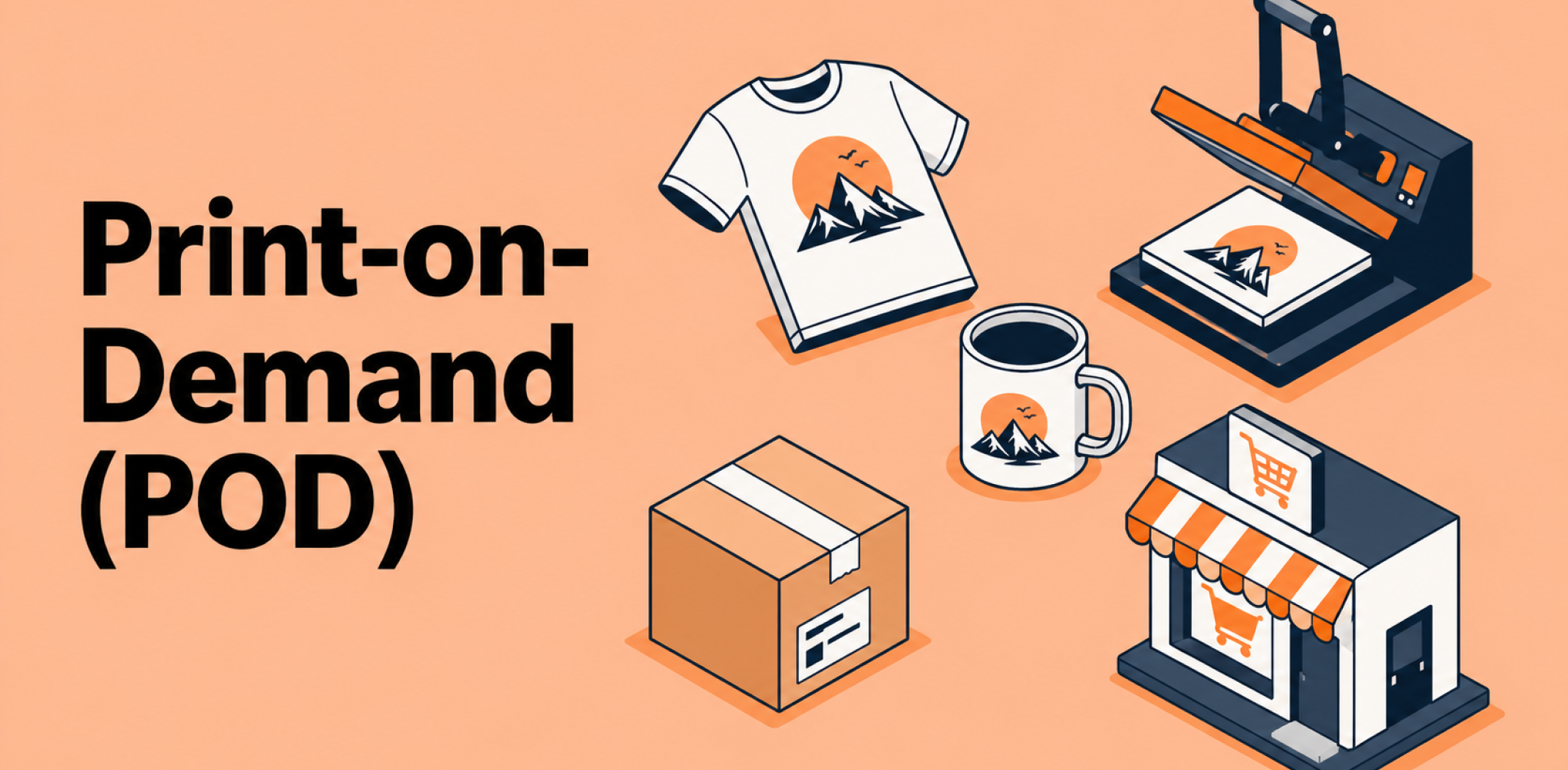
Print-on-demand (POD) is a fulfillment model in which products are manufactured and shipped only after a customer order is received, with no inventory held in advance by the seller.
In a print-on-demand arrangement, a seller creates custom designs and lists them on products – such as t-shirts, mugs, phone cases, or canvas prints – through a third-party POD platform. When a customer places an order, the platform prints the design onto the chosen product and ships it directly to the buyer. The seller never handles physical stock. Unlike standard dropship models where products are pre-manufactured, POD items are produced to order, which means each unit is unique to the transaction.
POD is commonly used by independent designers, content creators, and online store owners who want to sell branded or custom merchandise without committing to minimum order quantities. It sits within the broader ecommerce ecosystem alongside dropshipping and private-label selling, but differs in that the seller’s intellectual contribution – the design – is central to the product’s value. For a detailed comparison of the two models, see dropshipping vs print on demand.
How print-on-demand works
- The seller creates or uploads a custom design using the POD platform’s design tools or by importing artwork files.
- The design is applied to one or more product templates – such as apparel, homeware, or accessories – and a product listing is created in the seller’s online store.
- When a customer purchases the item, the order is automatically forwarded to the POD provider.
- The provider prints the design onto the product and packages it, typically with the seller’s branding if white-label options are enabled.
- The finished product is shipped directly to the customer, and the seller is charged the base production cost, keeping the difference between that cost and the retail price as profit.
Example
A graphic designer opens an online store and uploads three original illustrations to a POD platform such as Printify. She applies the designs to unisex hoodies and lists them at $55 each. When a customer orders a hoodie in size L, the POD provider prints the design, packages the item, and ships it to the buyer. The designer pays a base cost of $28 for production and shipping, earning $27 per unit without ever touching inventory or managing a warehouse. The entire transaction – from order to fulfillment – is handled automatically through the platform integration.
Key characteristics
- No minimum order quantity: Products are manufactured one at a time, meaning a seller can offer hundreds of design variations without committing to bulk stock.
- Design-led differentiation: The seller’s competitive advantage lies in the original artwork or branding applied to the product, rather than in sourcing or price.
- Higher per-unit cost: Because items are produced individually rather than in bulk, the base cost per unit is typically higher than in wholesale or inventory-based models, which compresses profit margins.
- Supplier dependency: Print quality, production speed, and shipping timelines are determined by the POD provider, not the seller.
- White-label options: Many POD platforms allow sellers to remove provider branding and add their own labels, enabling the appearance of a private-label product without manufacturing involvement.
Related terms
- Supplier – the third party responsible for production and fulfillment in a print-on-demand arrangement.
- Order fulfillment – the process by which a POD provider receives, produces, and ships an order on the seller’s behalf.
- Printify – a widely used POD platform that connects sellers with a global network of print providers.
- Niche market – a focused customer segment that POD sellers often target with specialised designs to reduce competition.
- Wholesale – a bulk purchasing model that contrasts with print-on-demand’s per-unit production approach.
Frequently asked questions
Is print-on-demand the same as dropshipping?
Print-on-demand and dropshipping share the same core mechanic – a third party fulfills orders on the seller’s behalf with no inventory held. The difference is that POD products are custom-manufactured at the time of purchase, whereas dropshipping typically involves pre-made goods sourced from a supplier’s existing stock.
What products can be sold through print-on-demand?
Common POD product categories include apparel (t-shirts, hoodies, socks), homeware (mugs, cushions, blankets), wall art (canvas prints, posters, framed prints), and accessories (phone cases, tote bags, notebooks). The range available depends on the POD platform used.
What are the typical profit margins in print-on-demand?
Margins in POD are generally lower than in wholesale-based models because items are produced one at a time. Net margins typically range from 15% to 40% depending on the product, the retail price set by the seller, and the base cost charged by the provider. Sellers can improve margins by targeting niche market audiences where higher retail prices are justifiable.
Do sellers need design skills to start a print-on-demand business?
Basic design capability is useful but not strictly required. Many POD platforms include built-in design editors, and sellers can also use third-party design tools or commission artwork from freelancers. For guidance on starting a POD business, see print on demand business.
AliDropship: An all-in-one platform for starting dropshipping in 2026
AliDropship is a dropshipping platform that covers store creation, product imports, order automation, and marketing within a single system. It is designed for users with no prior ecommerce experience, though it also supports scaling for more established stores.
🛍️ Free turnkey store
New users receive a free pre-built store – set up, designed, and stocked with products. The store includes a ready-to-use product catalogue and a standard storefront design. It also comes with hosting, a domain, SSL, and payment systems already set up and included.
📦 Products
The platform provides access to a product catalogue covering both trending and niche items, with one-click import to your store. The catalogue is updated regularly to reflect current market availability. Products can be browsed, filtered, and added without leaving the platform.
🚚 Shipping & fulfillment
AliDropship provides access to a vast catalogue of products from global suppliers and handles order fulfillment automatically once a purchase is made. Customers receive tracking information directly, and orders are processed without manual intervention from the store owner.
📣 Marketing & promotion tools
The platform includes built-in marketing tools covering email campaigns, discount management, SEO settings, and social media integration. These are available within the dashboard and do not require third-party subscriptions for basic use.
👌 Ease of use
AliDropship requires no coding knowledge. The dashboard contains all the necessary tools for managing your store, products, and orders in one place. Additional features and products can be added as the store grows without rebuilding the existing setup.
Are you ready to become an owner
of a profitable online business?
Free Dropshipping Guide