
Private-Label Dropshipping
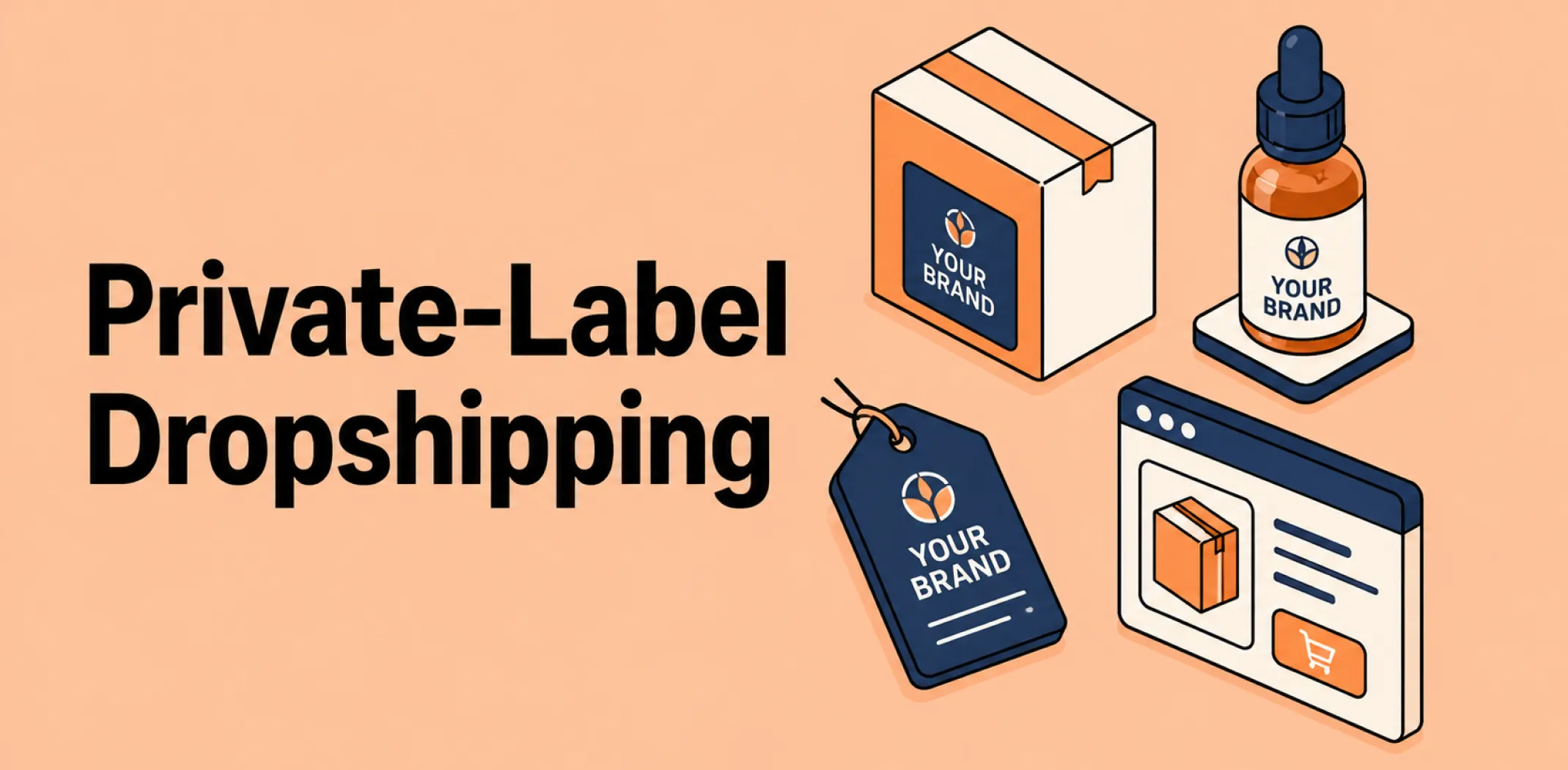
Private-label dropshipping is a fulfillment and branding model in which an online store sells products manufactured by a third party under its own brand name and logo, while the supplier continues to handle inventory storage and direct shipping to customers.
This model combines the low upfront risk of standard dropshipping with the brand equity benefits of private labeling. Unlike basic dropshipping – where products arrive in generic or supplier-branded packaging – private-label dropshipping allows the store owner to apply custom branding to the product itself (e.g., a logo on a water bottle) and its packaging (e.g., a custom box with inserts).
The supplier manufactures or sources unbranded white-label products, then applies the store owner’s branding before shipping. This creates a cohesive customer experience that can support higher pricing and repeat purchases.
Private-label dropshipping sits between standard dropshipping and full warehousing-based private labeling. The store owner gets brand control without committing to large minimum order quantities or managing physical stock. However, it typically requires closer supplier relationships and higher per-unit costs than standard unbranded dropshipping.
How private-label dropshipping works
- The store owner identifies a white-label product from a supplier that offers customization services – such as adding a logo to electronics, imprinting a design on apparel, or using custom packaging.
- The store owner and supplier agree on branding specifications (logo placement, colors, packaging design) and any minimum order quantities or setup fees for the customization process.
- The store owner lists the branded product on their ecommerce site at a retail price, using their own product photography and brand-aligned descriptions.
- When a customer places an order, the store owner forwards the order details to the supplier, specifying the branding applied (e.g., “logo on front, black box”).
- The supplier picks the base product from inventory, applies the custom branding (e.g., silk-screening, engraving, or inserting into a custom box), and ships the finished item directly to the customer under the store owner’s brand identity.
Example
A store owner creates a brand called “Apex Gear” selling fitness accessories. They find a supplier on AliExpress offering stainless steel water bottles with custom laser engraving. The owner pays a one-time mold fee of $50 and orders 50 units with “Apex Gear” and their logo engraved. For each customer order, the supplier engraves a fresh bottle and ships it in a custom-printed box designed by the owner. Customers receive a branded product that looks like it came from a dedicated fitness brand, allowing Apex Gear to charge $34.99 for a bottle that costs $12.50 landed.
Key characteristics
- Brand ownership: The store owner legally owns the brand identity applied to the product, not the supplier. The supplier acts as a contract manufacturer for customized units.
- Customization lead time: Adding branding extends fulfillment time because the supplier must perform an extra production step (engraving, printing, packaging) before shipping.
- Setup costs and minimums: Most private-label dropshipping arrangements require upfront fees for molds, screens, or design work, plus minimum order quantities – often 50–500 units – before a supplier agrees to hold branded stock.
- Quality control dependency: Brand quality is tied to the supplier’s workmanship on the customization itself, such as print alignment or engraving depth, which directly affects customer perception of the store’s brand.
Related terms
- Blind dropshipping – a related model where packaging uses no supplier branding but also carries no store branding, resulting in neutral packaging rather than customized brand presentation.
- White-label product – a generic base product manufactured for any seller to brand, which is the necessary input for private-label dropshipping.
- Brand building – the strategic process of creating a distinct brand identity, which private-label dropshipping supports through consistent product presentation and packaging.
- Supplier – the third party that both manufactures or sources the base product and applies the store’s custom branding before shipping.
Frequently asked questions
Is private-label dropshipping profitable?
Private-label dropshipping typically yields higher per-unit profit margins than standard dropshipping because customers are willing to pay more for branded products. However, upfront costs for molds, custom packaging, and minimum order quantities mean the store owner must accurately forecast demand to avoid losses on unsold customized inventory.
What is the difference between private label and white label in dropshipping?
A white-label product is a generic, unbranded product made by a manufacturer. Private label is the process of adding your brand to that white-label product. In dropshipping, white-label is the input (the blank item), while private-label dropshipping is the complete fulfillment model that applies your branding before shipping to the customer.
Can you private-label dropship from AliExpress?
Yes, many AliExpress suppliers offer private-label services such as custom logos, engraving, and custom packaging. The store owner typically contacts the supplier directly to negotiate setup fees and minimum orders, then processes branded orders through the standard AliExpress checkout while including customization instructions for each order.
Do you need a trademark for private-label dropshipping?
No, a registered trademark is not legally required to sell private-label products, but it is recommended. Without a trademark, other sellers may legally use the same brand name. A registered trademark provides legal protection to prevent competitors from copying your brand identity and allows you to enforce brand gating on some marketplaces.
AliDropship: An all-in-one platform for starting dropshipping in 2026
AliDropship is a dropshipping platform that covers store creation, product imports, order automation, and marketing within a single system. It is designed for users with no prior ecommerce experience, though it also supports scaling for more established stores.
🛍️ Free turnkey store
New users receive a free pre-built store – set up, designed, and stocked with products. The store includes a ready-to-use product catalogue and a standard storefront design. It also comes with hosting, a domain, SSL, and payment systems already set up and included.
📦 Products
The platform provides access to a product catalogue covering both trending and niche items, with one-click import to your store. The catalogue is updated regularly to reflect current market availability. Products can be browsed, filtered, and added without leaving the platform.
🚚 Shipping & fulfillment
AliDropship provides access to a vast catalogue of products from global suppliers and handles order fulfillment automatically once a purchase is made. Customers receive tracking information directly, and orders are processed without manual intervention from the store owner.
📣 Marketing & promotion tools
The platform includes built-in marketing tools covering email campaigns, discount management, SEO settings, and social media integration. These are available within the dashboard and do not require third-party subscriptions for basic use.
👌 Ease of use
AliDropship requires no coding knowledge. The dashboard contains all the necessary tools for managing your store, products, and orders in one place. Additional features and products can be added as the store grows without rebuilding the existing setup.
Are you ready to become an owner
of a profitable online business?
Free Dropshipping Guide