
Return On Ad Spend (ROAS)
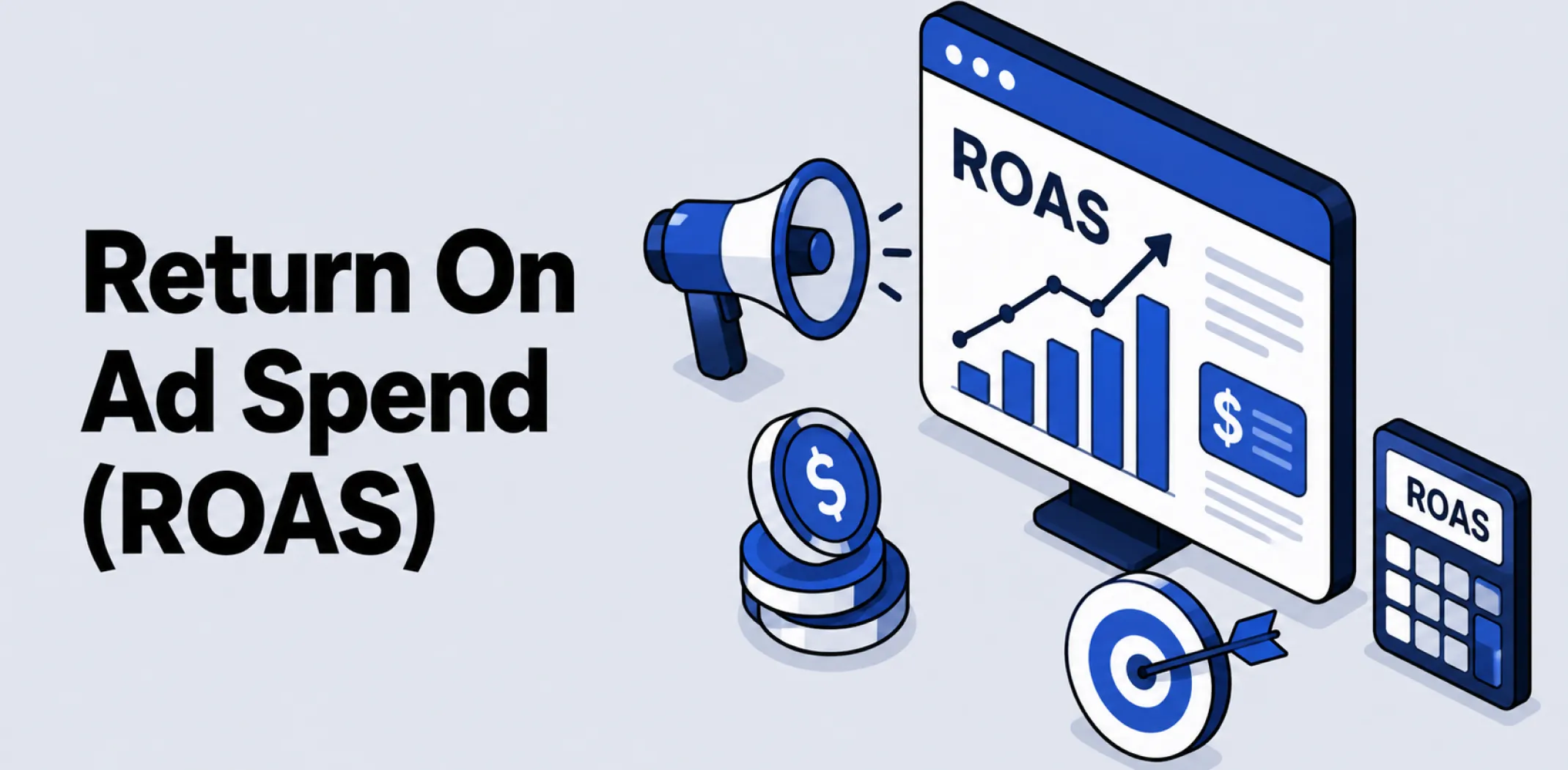
Return on ad spend (ROAS) is a marketing metric that measures how much revenue is generated for every dollar spent on advertising, expressed as a ratio or multiple of the ad cost.
ROAS is calculated by dividing total revenue attributed to an ad campaign by the total cost of that campaign. A result of 4, for example, means the campaign returned $4 in revenue for every $1 spent. Unlike return on investment, which accounts for all business costs, ROAS isolates advertising spend specifically, making it a focused measure of ad efficiency rather than overall profitability.
In ecommerce and dropshipping, ROAS is used to evaluate individual campaigns, ad sets, and channels. It helps sellers identify which advertising efforts are generating revenue at an acceptable ratio and which are underperforming relative to their cost. ROAS does not account for overhead costs, product costs, or platform fees, so a high ROAS does not automatically indicate a profitable store – it indicates ad efficiency only.
Example
A dropshipping store runs a Facebook ad campaign promoting a home organiser product over two weeks, spending $500 in total. During that period, the campaign drives $2,500 in revenue from attributed purchases. Dividing $2,500 by $500 gives a ROAS of 5x. The store owner compares this against a separate Google Shopping campaign for the same product, which spent $300 and returned $900 – a ROAS of 3x. Based on this comparison, the owner reallocates a larger share of the following month’s budget toward the Facebook campaign. Understanding ROAS in the context of product advertising helps sellers make data-driven budget decisions rather than relying on intuition.
Key characteristics
- Formula: ROAS is calculated as total ad revenue divided by total ad spend, typically expressed as a ratio (e.g., 4:1) or a multiple (e.g., 4x).
- Scope: ROAS measures the performance of advertising spend only – it does not factor in product cost, shipping, platform fees, or other operating expenses.
- Benchmark dependency: What counts as a “good” ROAS varies by industry, product margin, and business model; a store with thin margins may need a ROAS of 6x or higher to remain profitable, while a high-margin product may be viable at 2x.
- Attribution sensitivity: ROAS figures shift depending on the attribution model used (last-click, first-click, or data-driven), meaning the same campaign can show different ROAS values across different reporting platforms.
- Channel comparability: ROAS enables direct comparison across advertising channels – paid social, search, display, and influencer – using a single standardised metric.
Related terms
- Return on investment – a broader profitability metric that accounts for all costs, not just advertising spend.
- Product advertising – the practice of promoting specific products through paid channels, where ROAS is a primary performance measure.
- Conversion funnel – the staged path from ad impression to completed purchase that determines which revenue is attributed to an ad campaign.
- Average order value – the mean revenue per transaction, which directly influences ROAS when ad spend remains constant.
- Customer lifetime value – a long-term revenue metric sometimes used alongside ROAS to assess whether acquiring a customer at a given ad cost is worthwhile over time.
Frequently asked questions
What is a good ROAS for a dropshipping store?
There is no universal benchmark. A commonly cited starting point is 4x (returning $4 for every $1 spent), but the minimum acceptable ROAS depends on product margins and fixed costs. A store with low margins may require 6x or higher to turn a profit, while a higher-margin product can remain viable at a lower ratio. Sellers should calculate their break-even ROAS based on their actual cost structure before setting targets.
What is the difference between ROAS and ROI?
ROAS measures revenue relative to advertising spend only, while return on investment (ROI) measures net profit relative to total costs, including product cost, shipping, fees, and overhead. A campaign can show a strong ROAS while still producing a negative ROI if other costs are high. Both metrics serve different purposes and are most useful when analysed together.
How is ROAS calculated?
ROAS = Total Revenue from Ads ÷ Total Ad Spend. For example, if a campaign generates $3,000 in revenue and costs $600 to run, the ROAS is 5 (or 5x). Most advertising platforms – including Google Ads and Meta Ads Manager – calculate and report ROAS automatically within their dashboards, though attribution settings affect the figures shown.
Can ROAS be misleading?
Yes. ROAS reflects revenue, not profit, so a high ROAS does not guarantee a profitable campaign if product costs and fees are significant. Attribution models also affect reported ROAS – a campaign credited with a sale under last-click attribution may not have been the primary driver of that purchase. Sellers should treat ROAS as one signal within a broader set of performance metrics rather than a standalone measure of success.
AliDropship: An all-in-one platform for starting dropshipping in 2026
AliDropship is a dropshipping platform that covers store creation, product imports, order automation, and marketing within a single system. It is designed for users with no prior ecommerce experience, though it also supports scaling for more established stores.
🛍️ Free turnkey store
New users receive a free pre-built store – set up, designed, and stocked with products. The store includes a ready-to-use product catalogue and a standard storefront design. It also comes with hosting, a domain, SSL, and payment systems already set up and included.
📦 Products
The platform provides access to a product catalogue covering both trending and niche items, with one-click import to your store. The catalogue is updated regularly to reflect current market availability. Products can be browsed, filtered, and added without leaving the platform.
🚚 Shipping & fulfillment
AliDropship provides access to a vast catalogue of products from global suppliers and handles order fulfillment automatically once a purchase is made. Customers receive tracking information directly, and orders are processed without manual intervention from the store owner.
📣 Marketing & promotion tools
The platform includes built-in marketing tools covering email campaigns, discount management, SEO settings, and social media integration. These are available within the dashboard and do not require third-party subscriptions for basic use.
👌 Ease of use
AliDropship requires no coding knowledge. The dashboard contains all the necessary tools for managing your store, products, and orders in one place. Additional features and products can be added as the store grows without rebuilding the existing setup.
Are you ready to become an owner
of a profitable online business?
Free Dropshipping Guide